Turbo Petrol Engines (TSI, GDi, Boosterjet) & E20: Carbon Buildup & HPFP Wear Guide
Explore how 20% ethanol blending impacts modern direct-injection turbo petrol engines (VW 1.0/1.5 TSI, Hyundai 1.5 Turbo GDi, Mahindra mStallion). Learn about carbon buildup, HPFP plunger wear, and E0 solutions.
Key Takeaways for Indian Motorists:
- Direct-injection (GDi/TSI) engines inject fuel directly into the combustion chamber at 200–350 bar, making high-pressure fuel pumps (HPFP) vulnerable to ethanol's poor lubricity.
- Without intake port fuel wash, ethanol-induced combustion soot accelerates heavy carbon crusting on intake valves within 30,000 km.
- E20 fuel causes long-cranking cold starts and low-RPM shuddering in DSG / DCT dual-clutch turbo petrol cars in urban traffic.
- Periodic fills of verified 0% ethanol petrol (XP100) clean direct injectors and prevent catastrophic high-pressure pump plunger scoring.
Table of Contents
Modern Turbo Petrols Meet Indian E20 Blends
The Indian car market has transitioned rapidly from diesels to high-tech Direct-Injection Turbo Petrols—including the Volkswagen-Skoda 1.0 & 1.5 TSI, Hyundai-Kia 1.5 Turbo GDi, Mahindra mStallion 2.0 Turbo, and Maruti Suzuki Boosterjet.
These engines rely on ultra-high injection pressures (200 to 350 bar) and precise multi-hole solenoid injectors. However, the nationwide rollout of 20% ethanol fuel is presenting unexpected maintenance challenges for Indian car owners.
The Three Critical Failure Points on Turbo Direct-Injection Engines
1. High-Pressure Fuel Pump (HPFP) Plunger Scoring
Unlike port-injected engines that run at a modest 3.5 bar, GDi and TSI engines utilize a camshaft-driven high-pressure mechanical fuel pump.
- Petrol acts as the internal lubricant for the pump's precision-machined plunger.
- Ethanol acts as a chemical solvent that strips away protective lubricating film.
- Result: Micro-scoring on the pump plunger, fuel pressure drops under boost, and costly ₹45,000+ HPFP replacements.
2. Intake Valve Carbon Crust (No Port Wash)
In direct-injection engines, fuel is sprayed directly into the cylinder, never washing the back of the intake valves. The incomplete combustion of ethanol-heavy fuel in stop-and-go city traffic produces sticky carbon deposits that bake onto intake valves, resulting in:
- Rough idle and jerky low-speed throttle response.
- Significant reduction in volumetric efficiency and turbo boost spool-up speed.
3. Low-Speed Pre-Ignition (LSPI) Risk
Turbo direct-injection engines are prone to Low-Speed Pre-Ignition (LSPI)—an uncontrolled explosion before the spark plug fires when accelerating hard from low RPMs. Lower-density, moisture-laden ethanol blends increase cylinder hot spots, escalating the risk of bent connecting rods and cracked pistons.
How E0 Finder Protects Your Turbo Petrol Car
Automotive engineers recommend fueling with verified 0% Ethanol High-Octane Petrol (XP100 / poWer100):
- Restores essential fuel system lubrication for the high-pressure fuel pump.
- Provides crisp low-RPM turbo spool without throttle flat spots.
- Eliminates water pooling in the fuel tank during long parking intervals.
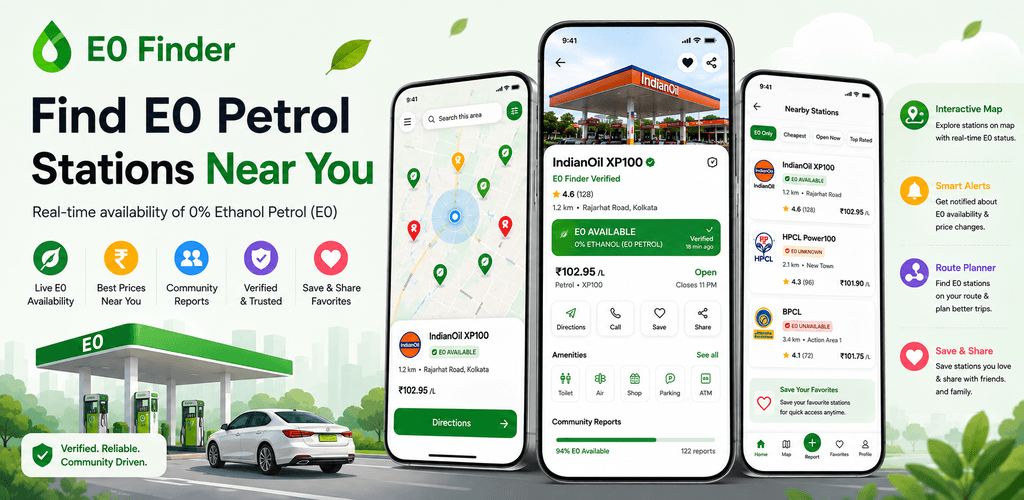
Download E0 Finder on Android to find verified 0% ethanol petrol stations near your commute!
Calculate Your Fuel & Maintenance Savings
See how much fuel and preventive repair costs your bike or car saves on pure E0 petrol.
Visual Evidence & E0 Finder In-App Verification



Find 0% Ethanol Petrol Near You Instantly
Download E0 Finder for Android. Real-time verified pumps, live density logs (Form-8), turn-by-turn navigation, and crowd-verified reports across 500+ Indian cities.